Wednesday, November 28, 2012

Holiday Gift Guide 2012 - Gifts to promote gross motor development

Today I am sharing toys and games that help promote the development of gross motor skills. Gross motor skills include so much more than just walking. Read on for suggestions to get your child crawling, throwing, jumping, pedaling, and more!

Babies:

Babies develop SO much in the first year of life. Rolling, sitting, crawling, walking...here are some suggestions to help develop those skills.


- There are SO many activity tables out there for babies, which means it is fairly easy to find a gently used one at a thrift store, a yard sale, or on Craigslist. Activity tables can be used to develop a variety of gross motor skills (tummy time, sitting, standing), and as a bonus, they also help develop fine motor and cognitive skills too!

- The Step Start Walk 'n Ride is a push toy that converts into a ride on toy. While this toy is not the most sturdy for very early walkers, it is great for children with special needs who need a little extra practice with walking before it becomes a solid skill. Then fold it into the ride on toy to further develop gross motor skills!

- The design of the Oball makes it easy for little hands to grasp and the sound of the beads inside the ball makes the ball even more interesting to babies. The Oball is a great introduction to early ball skills.

- This is another great "baby's first ball" to introduce early ball skills, such as rolling and grasping the ball. The tags and the high contrast fabric make the ball even more engaging for babies.


- The VTech Move and Crawl Activity Ball is engaging and motivating, encouraging your child to crawl after it. As an added bonus, the buttons and tags help develop fine motor and cognitive skills, too!

Toddlers:

Anyone who knows a toddler knows that they are on the move! Below are some toy suggestions to focus that energy on developing specific gross motor skills.


- The Gertie Ball has a fun, knobby texture, and is easy for toddlers learning to catch and throw.

- Catch the butterflys in the net to develop eye hand coordination.

- This bowling set from Melissa and Doug is another toy that helps develop eye hand coordination.

- The wide base of this scooter does make it a good first scooter, providing extra support and stability for toddlers who want to use a scooter, but don't quite have the balance for a more "grown up" scooter.

Preschoolers:

Preschoolers continue to move and explore their environment. It is at this age that children begin to show even more independence in activities that require gross motor skills, like riding a tricycle.

Original Toy Company Fold and Go Trampoline

- A trampoline with a handle is great for developing leg strength and gross motor skills.


- This scooter is the next step up from My First Scooter. The narrower base of this scooter helps develop balance and coordination.


- A tricycle further develops leg strength, balance and coordination, preparing children for bike riding skills. 

- This kickball by Melissa and Doug is a little smaller than a traditional kickball, making it easier for those just learning how to kick.


- This basketball hoop by Fisher Price will grow with your child as his or her skills develop.

- Feed the Woozle is an interactive game that not only promotes gross motor development, it also develops counting skills, fine motor skills, body awareness, turn taking, and more! 

- Super Stretchy ABCs is like Twister for preschoolers. Works on letter recognition and gross motor skills!

School-age Children:

Once children reach school age,gross motor skills become even more refined and complex. Developing balance and coordination will help develop the skills required to ride a bike or play organized sports.


- I would say a Razor Scooter is the final step in scooters. The narrow base of this scooter really challenges balance and coordination skills.

- Twister is a fun way to work on left/right skills as well as gross motor skills.

- I use a balance board almost everyday in therapy to work on core strength and balance skills. This monkey balance board is fun for young children.

 
- The Wobble Deck is a more advanced balance board. It "wobbles" in all directions and is like Simon Says meets a balance board. 

Looking for even more ideas? Be sure to check out my Amazon Store!

*This post contains affiliate links.
 

Tuesday, November 27, 2012

Holiday Gift Guide 2012 - Gifts to promote fine motor development

Today I am sharing toys and games to promote the development of fine motor skills. Fine motor skills are the foundation for many self-help skills, such as zipping, buttoning and shoe tying, as well as the precursor to many school skills, such as handwriting skills scissor use. Read on for toy and games suggestions to develop fine motor skills.

Babies:

Babies explore their environment through reaching, grasping, and sensory exploration. Here are a few toy suggestion to help facilitate that development. 

- Infant rings develop early reaching and grasping skills.

- Rattles are also great for developing reaching and grasping skills, as well as visual tracking.


- For the older babies in your life, a toy piggy bank is great for further developing hand eye coordination.

Toddlers:

Toddlers are learning to use both of their hands together and to coordinate both sides of their bodies to do more complex activities.

- Lacing beads is a great way to develop bilateral coordination skills (using both hands together). These beads from Melissa and Doug are great (and you really can't go wrong with any Melissa and Doug toy).

- There are many great recipes available for play dough (like this DIY Jello Play Dough), but the original is great too! Play Doh and Play Doh accessories, like this set from Melissa and Doug, are great for developing hand muscles and early tool use.

 
- A classic pounding bench works on developing hand eye coordination. 

 
- Toddlers are beginning to color, but that coloring sometimes extends to every surface of the house! If you'd like to avoid that, Mess Free Markers are a good option. The only downside is, you will also need the appropriate paper to go with these markers.

Preschoolers:

Preschoolers like to build, use their imagination, and love to let their artistic abilities shine. Why not further develop fine motor skills while building, playing imaginative games and creating pieces of art?


- I love the Sneaky Snacky Squirrel Game! This is a great first board game. I love that it works on counting and color skills, AND has a fun squirrel tong that develops fine motor skills, too!

- A Potato Head (whether it's a Mr. or a Mrs.) is a great way to work on body parts and fine motor skills at the same time. With all of the different Potato Heads out there, you are sure to find one to please your child.

- Little markers are great for little hands to promote an appropriate grasp. Crayola Pip Squeaks fit the bill perfectly.

- Using a vertical surface when coloring, like an easel, places the wrist in extension and strengthens little hands to get them ready for writing.


 - DUPLO bricks develop hand muscles and fine motor skills, while encouraging creativity.

School-age Children:

School-age children are fine tuning their motor skills, as well as learning more complex fine motor movements. Building toys and games are a great way to promote these skills.

 
- Operation is a classic game that requires fine motor precision to play. This is probably not the best choice if your child is sensitive to sounds.


- LEGO bricks develop hand muscles and fine motor skills and are the next step up from DUPLO bricks. With so many great LEGO sets to choose from, I'm sure you can find a set that matches your child's interests.

 
- For the budding engineer in your life, Snap Circuits and Snap Circuits, Jr develop fine motor and visual motor skills, while creating working electronic circuits and devices.

- I'm not recommending Silly Putty just because I love classic toys from my childhood. Silly Putty is a fun way to develop hand muscles. Hide small beads in the Silly Putty and have your child locate them for more of a challenge. Silly Putty also makes a great stocking stuffer!

Looking for even more ideas? Be sure to check out my Amazon Store!

*This post contains affiliate links.
 

Monday, November 26, 2012

Holiday Gift Guide 2012 - Gifts for children with visual impairments

Today I'll be sharing some toy suggestions for children who are visually impaired. When choosing a toy for a child with a visual impairment, remember to keep the following in mind:
  • Does the toy provide multi-sensory exploration (i.e. sounds, lights, textures)?
  • Is the toy high contrast (i.e. black and white)?
  • Does the toy make use of my child's vision?
  • Is the toy easy for my child to manipulate?

Babies:

All babies are beginning to explore their environment through reaching, grasping, and sensory exploration. Here are some toy suggestions to help your baby with a visual impairment to reach, grasp, and explore his environment.

- The design of the Oball makes it easy for little hands to grasp and the sound of the beads inside the ball makes the ball even more interesting to babies. As your baby grows and becomes more interested in balls, the auditory feedback provided by the beads inside the ball will be helpful to your toddler with a visual impairment.

- The Oball Shaker is also great for little hands to grasp and contains beads to make a shaking sound.


- Rings encourage grasping in babies and a variety of textures are great for sensory exploration. I also like that these Sassy rings have a high contrast ring to hold the rings together as one unit.


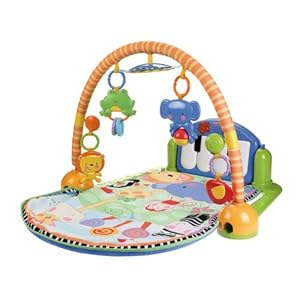
- A kick and play piano is great for encouraging leg movements and provides auditory and visual feedback by playing music and lighting up when activated.


- I love the high contrast provided by this Wimmer-Ferguson play mat by Manhattan Toy. The contrast provided by black and white is great for all babies and especially babies with a visual impairment.

 
- The Wimmer Ferguson series by Manhattan Toy also has these great high contrast shapes. The pyramid jingles, the ball crinkles, and the cube rattles.


-While we're on the topic of high contrast (are you seeing a theme here?), we can't forget board books for babies. Shasta, the mother of a child with cerebral palsy, has written and published a board book, Dark & Light: A Love Story in Black and White. As a bonus, all proceeds go toward her son's therapy expenses!


Toddlers:

Toddlers continue to learn through their senses and they are also on the move! Here are toys that will help your toddler learn and grow.

 
- Use these textured squares to work on matching and sorting. The textures are great for children with visual impairment and if you are handy with a sewing machine, you could save some money and easily make something similar yourself.


- The knobby texture of the Gertie Ball makes it great for toddlers with a visual impairment learning ball skills.

Sound Puzzle with Braille Pieces Talking Shapes


- A talking puzzle like this one from Melissa and Doug is great for to help toddlers identify shapes by touch and sound. As an added bonus, this puzzle also includes Braille. If you're interested in more puzzles with Braille, Melissa and Doug have a series of puzzles that contain Braille.

Uncle Goose Braille Alphabet Blocks
- If your child will be learning Braille, these alphabet blocks are a great introduction to the letters. There is also a math set that might be more appropriate for slightly older children.

That's Not My Puppy (Usborne Touchy-Feely Board Books)


- Toddlers love to look at books. For the toddler with a visual impairment, there are a number of fantastic touch and feel books available for a more engaging experience.

Preschoolers:

Preschoolers continue to grow and learn. This is also the age when children become more interested in building things.

Winfun Step To Play Giant Piano Mat

- A Floor Mat Piano, such as this one from WinFun, will encourage your child to get up and dance around.

Original Toy Company Fold and Go Trampoline

- A trampoline with a handle will help your preschooler develop jumping and gross motor skills.

Gymnic / 22" Jinglin' Ball

- This ball with jinging bells inside provides great auditory feedback for children learning ball skills.

Battat Bristle Block 85 Piece Set

- I mentioned that preschoolers like to build. The textured surface of Bristle Blocks make them great for children with a visual impairment to manipulate.

SENSEsational Alphabet Touch and Feel Picture Cards

- These SENSEsational Alphabet Touch and Feel Picture Cards are a multi-sensory tool for learning the alphabet.

Sanford Mr. Sketch Assorted Scent Markers 12 Pack (20072)

- Scented Markers make coloring a multi-sensory activity for children with a vision impairment.


School-aged Children:

When children reach elementary school age, they begin playing more games with their peers. Here are some game and toy suggestions suitable for children with a visual impairments.


- Bop It is a fun game that relies on listening skills, as it gives verbal commands for various movements (e.g. twist it, pull it, spin it).

Double-Six Dominoes; Wooden (With Raised Dots)

- This set of dominoes has raised dots, making it easier for a child with a visual impairment to access the dominoes.

Reizen Braille Jumbo Print Playing Cards 2 Pack

- These playing cards contain both large print and Braille.

Braille Board Games

- In addition to large print playing cards, a few board games and card games are available in versions that contain large print and/or Braille, including Scrabble, Monopoly, Yahtzee, Go Fish, Old Maid, and Uno.

Looking for even more ideas? Be sure to check out my Amazon Store!

*This post contains affiliate links.
 

Sunday, November 25, 2012

Welcome to the 2012 Holiday Gift Guide

With Thanksgiving behind us, I am now willing to think about shopping for the December holidays. Last year, I created a Holiday Gift Guide with suggestions for various age groups (babies, toddlers, preschoolers, and elementary school age children). Since I still believe those lists contain good gift suggestions for various age groups, I decided to do my Holiday Gift Guide a little differently this year.

Each day this week I will focus on a specific skill set or impairment, and suggest age appropriate gifts to promote development in that area. Know a child with a visual impairment? Check back tomorrow for ideas. Looking for a gift for a child who's been labeled as a "sensory seeker?" We'll cover that on Thursday. Looking for gifts to promote specific skills? I'll be covering fine motor skills on Tuesday and gross motor skills on Wednesday. 

On Friday I plan to do a roundup of other great gift guides I've come across, so if you have one you would like me to share, please leave a comment below or send me an email.

If you don't find what you're looking for in the gift guides this week, you can always visit my Amazon Store for even more ideas!

When buying gifts for children with special needs, it is always important to consider the child's developmental age. The National Lekotek Center has 10 questions to ask when choosing a developmentally appropriate toy. Also, AOTA has developed a Checklist for Toy Shopping, which is a great tool for evaluating a potential toy to make sure you are getting the most developmental bang for your buck, prior to purchasing the toy.

Stop by tomorrow to check out the first 2012 Holiday Gift Guide!

*This post contains affiliate links.

You might also enjoy: